Quick answer: Salmon calories range from about 140 to 230 per 100 g cooked, depending on the species. Farmed Atlantic salmon has about 206 calories per 100 g cooked, wild Atlantic about 182, sockeye about 156 and wild coho about 139, according to USDA FoodData Central.
Table of Contents
Salmon calories at a glance
Salmon calories depend mostly on one thing: how much fat the fish carries. Protein stays fairly steady at 22 to 27 g per 100 g cooked, while fat swings from about 4 g in wild coho to more than 13 g in chinook. Every value below comes from the USDA SR Legacy database for fish cooked with dry heat (baked, grilled or broiled) and no added fat.
| Salmon type (cooked, dry heat) | Calories per 100 g | Calories per 3 oz (85 g) | Protein per 3 oz | Fat per 3 oz |
|---|---|---|---|---|
| Atlantic, farmed | 206 | 175 | 18.8 g | 10.5 g |
| Atlantic, wild | 182 | 155 | 21.6 g | 6.9 g |
| Chinook (king) | 231 | 196 | 21.9 g | 11.4 g |
| Coho, farmed | 178 | 151 | 20.7 g | 7.0 g |
| Coho, wild | 139 | 118 | 19.9 g | 3.7 g |
| Sockeye (red) | 156 | 133 | 22.5 g | 4.7 g |
| Pink | 153 | 130 | 20.9 g | 4.5 g |
Salmon has no carbohydrate, so nearly all of its energy comes from protein and fat. A 3 oz cooked portion is roughly the size of a deck of cards and is the serving size used in most nutrition tables.
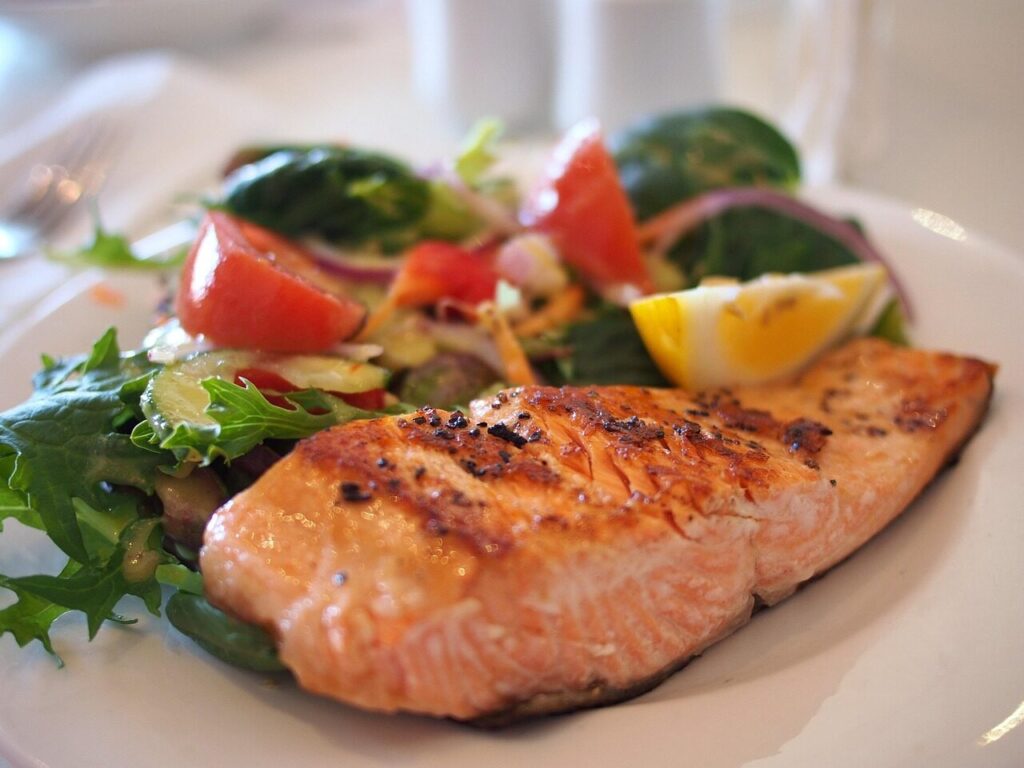
Salmon calories per fillet and per portion
Per 100 g figures are useful, but most people don’t weigh fish, so it helps to know what a typical piece adds up to. USDA lists household weights for half a fillet of each species, which is close to what a restaurant or supermarket portion looks like.
| Portion (cooked) | Weight | Calories | Protein | Fat |
|---|---|---|---|---|
| Farmed Atlantic, half fillet | 178 g | 367 | 39.3 g | 22.0 g |
| Farmed Atlantic, 4 oz piece | 113 g | 233 | 25.0 g | 14.0 g |
| Farmed Atlantic, 6 oz piece | 170 g | 350 | 37.6 g | 21.0 g |
| Wild Atlantic, half fillet | 154 g | 280 | 39.2 g | 12.5 g |
| Sockeye, half fillet | 155 g | 242 | 41.0 g | 8.6 g |
| Wild coho, half fillet | 178 g | 247 | 41.7 g | 7.7 g |
| Chinook, half fillet | 154 g | 356 | 39.6 g | 20.6 g |
| Pink, half fillet | 124 g | 190 | 30.5 g | 6.5 g |
A 6 oz raw piece of farmed Atlantic salmon (170 g) has about 354 calories before cooking. It loses water in the oven, so the cooked piece weighs less, but the total calories stay about the same unless you add oil or butter.
Raw vs cooked weight
Cooking concentrates the numbers per gram because water leaves the fish. Farmed Atlantic salmon has 208 calories per 100 g raw and 206 cooked, almost identical. Wild Atlantic goes from 142 raw to 182 cooked, and sockeye from 131 to 156. If you log your food, weigh it the same way every time and choose the matching raw or cooked entry. Our guide on how to track calories explains why that matters.
Wild vs farmed salmon calories
Farmed salmon is fed a controlled, energy-dense diet and swims less, so it stores more fat. That is the main reason farmed salmon calories run higher than wild.
- Farmed Atlantic: 175 calories and 10.5 g fat per 3 oz cooked.
- Wild Atlantic: 155 calories and 6.9 g fat per 3 oz cooked.
- Wild sockeye: 133 calories and 4.7 g fat per 3 oz cooked.
- Wild coho: 118 calories and 3.7 g fat per 3 oz cooked.
The difference is real but modest: about 40 to 60 calories per serving. Both kinds are good protein choices. The extra fat in farmed fish is mostly unsaturated, and it is part of why salmon is valued as a source of omega-3 fats. If you are watching your budget closely, wild sockeye, coho or pink give you the most protein for the fewest calories.
Canned and smoked salmon calories
Canned and smoked salmon are easy, ready-to-eat options. Their calories stay low, but sodium changes a lot.
| Product | Serving | Calories | Protein | Sodium |
|---|---|---|---|---|
| Canned pink, drained | 3 oz (85 g) | 116 | 20.9 g | 321 mg |
| Canned sockeye, drained | 3 oz (85 g) | 134 | 22.4 g | 328 mg |
| Smoked salmon (lox) | 1 oz (28 g) | 33 | 5.2 g | 567 mg |
| Smoked salmon (lox) | 2 oz (57 g) | 66 | 10.4 g | 1,134 mg |
Canned pink salmon is one of the lowest options for salmon calories and costs less than fresh fillets. Smoked salmon is light in calories too, but 2 oz already carries about half of the 2,300 mg daily sodium limit in the Dietary Guidelines for Americans. Enjoy lox as a topping rather than the main protein.
How cooking method changes salmon calories
The fish itself doesn’t gain calories in the oven. What you add does. Using USDA values for fats:
- 1 teaspoon olive oil: about 40 calories.
- 1 tablespoon olive oil: about 119 calories.
- 1 tablespoon butter: about 102 calories.
So a 4 oz farmed fillet goes from about 233 calories to around 350 if it is pan-seared in a tablespoon of oil, and higher still with a creamy sauce or a crispy coating. Baking on parchment, grilling, air frying or poaching keeps salmon calories close to the table above. Brush on a teaspoon of oil, or use a light spray, and lean on lemon, garlic, herbs, mustard or a little soy sauce for flavour.
Safe cooking temperature
FoodSafety.gov lists 145°F (63°C) as the safe minimum internal temperature for fish, or cook until the flesh is opaque and separates easily with a fork. See the FoodSafety.gov safe minimum temperatures chart for details.
How salmon compares with other proteins
Here is how salmon calories stack up against other common proteins, per 3 oz cooked, with all values from USDA.
| Protein (3 oz cooked) | Calories | Protein | Fat |
|---|---|---|---|
| Cod | 89 | 19.4 g | 0.7 g |
| Tuna, light, canned in water | 99 | 21.7 g | 0.7 g |
| Tilapia | 109 | 22.2 g | 2.3 g |
| Sockeye salmon | 133 | 22.5 g | 4.7 g |
| Chicken breast, roasted | 140 | 26.4 g | 3.0 g |
| Rainbow trout, farmed | 143 | 20.2 g | 6.3 g |
| Farmed Atlantic salmon | 175 | 18.8 g | 10.5 g |
| Lean ground beef (90%) | 184 | 22.2 g | 10.0 g |
White fish and chicken breast calories come out lower, but salmon gives you more fat in the form that many people want more of. For a lighter week, mix salmon with leaner proteins rather than replacing it.
Is salmon good for a lower-calorie diet?
Yes, for most people. A 3 to 4 oz portion fits easily into a 400 to 500 calorie meal once you add vegetables and a modest starch. The protein helps keep you full, and the FDA lists salmon among its “best choices” for fish because it is lower in mercury. You can read more in the FDA’s advice about eating fish.
Some easy plates to build:
- Sheet-pan salmon: 4 oz farmed salmon, 2 cups of cooked broccoli and a teaspoon of oil, about 380 calories.
- Salmon rice bowl: 3 oz sockeye and half a cup of cooked white rice come to about 236 calories before cucumber and a little avocado. Check our avocado calories guide to size the topping.
- Salmon and sweet potato: pair a wild fillet with a small baked sweet potato. Our sweet potato calories guide has the numbers.
For ready recipes, try these salmon skewers with zucchini, browse our dinner recipes, or add salmon to your high protein meal prep.
Common mistakes when counting salmon calories
- Guessing the portion. A restaurant fillet is often 6 to 8 oz, which can be double the 3 oz serving on most labels.
- Forgetting the oil and sauce. Glazes, butter and creamy sauces can add 100 to 250 calories.
- Mixing raw and cooked entries. Weighing cooked fish but logging a raw value skews the result.
- Using one number for all salmon. Chinook and farmed Atlantic sit near the top; coho, pink and sockeye sit near the bottom.
Buying and storing tips
Buy fillets that smell fresh and mild, with firm flesh that springs back. Keep raw salmon in the coldest part of the fridge and cook it within a day or two, or freeze it. Thaw frozen fish in the fridge overnight. Leftover cooked salmon keeps for 3 to 4 days in a sealed container and is great flaked into salads.
Frequently asked questions
How many salmon calories are in a 6 oz fillet?
A 6 oz (170 g) cooked piece of farmed Atlantic salmon has about 350 calories and 38 g protein. The same weight of cooked sockeye has about 265 calories.
Are salmon calories higher than chicken breast?
Usually a little. Per 3 oz cooked, farmed Atlantic salmon has about 175 calories and roasted chicken breast about 140. Sockeye, at about 133, is close to chicken.
Which salmon has the fewest calories?
Wild coho is among the lowest at about 118 calories per 3 oz cooked, followed by canned pink salmon (about 116 drained), pink and sockeye.
Does air frying salmon add calories?
Not by itself. Air frying only adds what you brush on. A teaspoon of olive oil adds about 40 calories, so a light coat keeps the fish close to its plain value.
Sources
- USDA FoodData Central: SR Legacy entries for Atlantic (farmed and wild), chinook, coho, sockeye and pink salmon, canned and smoked salmon, and the comparison proteins.
- FoodSafety.gov: Safe Minimum Internal Temperatures.
- FDA: Advice about Eating Fish.
- Dietary Guidelines for Americans: sodium limit.
Nutrition values are estimates based on USDA data and vary by fish, portion and cooking method. This article is general information, not medical advice.