Quick answer: Size is what drives the calories in an apple. One medium apple (182 g) provides roughly 95 calories, along with 25 g of carbs and 4.4 g of fiber. A small apple has about 77 calories, a large one about 116, and every 100 g of apple has 52 calories.
Table of Contents
Calories in an apple by size
The calories in an apple stay modest for such a satisfying snack, which is why apples show up in so many lunch bags. You can eat one on the go, it comes in its own natural portion, and there is nothing to cook. The figures below cover raw, unpeeled apples, from USDA FoodData Central.
| Apple size | Weight | Calories | Carbs | Fiber |
|---|---|---|---|---|
| Small (2.75 in across) | 149 g | 77 | 21 g | 3.6 g |
| Medium (3 in across) | 182 g | 95 | 25 g | 4.4 g |
| Large (3.25 in across) | 223 g | 116 | 31 g | 5.4 g |
| 1 cup slices | 109 g | 57 | 15 g | 2.6 g |
| Per 100 g | 100 g | 52 | 14 g | 2.4 g |
Plenty of grocery-store apples outgrow the USDA “medium” size, so if one fills your palm, log it as large. To be precise, put it on a kitchen scale and multiply its weight in grams by 0.52.
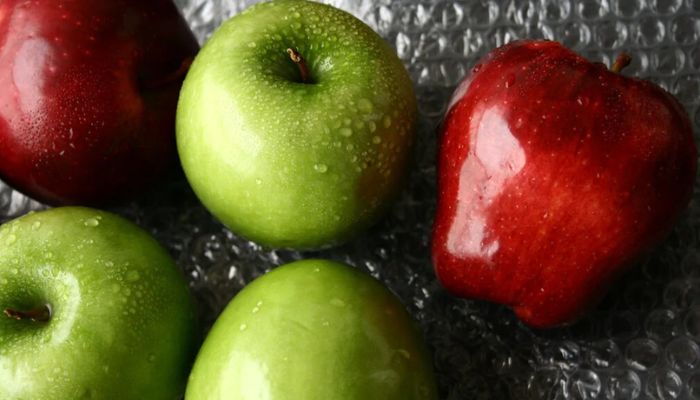
Nutrition facts for one medium apple
| Nutrient | Amount |
|---|---|
| Calories | 95 |
| Carbohydrate | 25 g |
| Sugars | 19 g |
| Fiber | 4.4 g |
| Protein | 0.5 g |
| Fat | 0.3 g |
Nearly every one of the calories in an apple comes from carbohydrate, mostly natural fruit sugars. The fiber is what makes the difference: 4.4 g is a useful share of the fiber most adults are encouraged to eat each day, and it helps an apple feel more satisfying than its calorie count suggests.
Calories in an apple by variety
Variety matters a little, but less than size. USDA lists slightly different calories per 100 g for common types, and its “medium” weights also differ by variety.
| Variety | Calories per 100 g | Medium apple (USDA weight) | Calories per medium |
|---|---|---|---|
| Fuji | 63 | 192 g | about 121 |
| Red Delicious | 59 | 212 g | about 125 |
| Granny Smith | 58 | 167 g | about 97 |
| Gala | 57 | 172 g | about 98 |
| Golden Delicious | 57 | 169 g | about 96 |
Sweet varieties such as Fuji have a few more calories per 100 g than tart Granny Smith, so the difference for a medium apple can reach 20 calories or so. Choose the variety you like best; the calories in an apple of any type stay modest, and a quick weigh-in settles the rest.
Peeled vs unpeeled apples
Peeling an apple trims only a few calories, but it removes a large share of the fiber. A medium peeled apple (161 g) has about 77 calories and 2.1 g of fiber, compared with 95 calories and 4.4 g of fiber for a medium apple with the skin on. Rinse the apple and keep the peel on for a more filling snack. In baked apples and crumbles, unpeeled slices also hold their shape better and look brighter.
How to estimate the calories in an apple without a scale
A kitchen scale gives the best answer, but you can get close without one:
- Compare it with your hand. An apple about the size of a tennis ball is small (around 77 calories). One that fills a closed fist is medium (around 95). One that is clearly bigger than your fist is large (around 116 or more).
- Check the label. Bags of apples often list a count per pound. Divide 454 g by the number of apples to estimate the weight of each, then multiply by 0.52.
- Count slices by the cup. A cup of slices is about 57 calories, which helps when apples go into salads or oatmeal.
These shortcuts put the calories in an apple within a small margin, which is close enough for most everyday tracking. When accuracy matters more, weigh the apple once or twice to train your eye, and estimating the calories in an apple quickly gets easier.
Calories in an apple compared with apple products
| Food | Typical serving | Calories | Fiber |
|---|---|---|---|
| Medium apple | 1 apple (182 g) | 95 | 4.4 g |
| Unsweetened applesauce | 1 cup (244 g) | 102 | 2.7 g |
| Apple juice, unsweetened | 1 cup (248 g) | 114 | 0.5 g |
| Dried apple | 1/4 cup (about 22 g) | 52 | 1.9 g |
A cup of juice beats a whole apple on calories while delivering only a trace of fiber, so it does little to keep hunger away. Dried apple works as a small add-in, but drying concentrates it, and a few handfuls can equal several fresh apples. Applesauce lands in the middle; choose unsweetened versions to avoid added sugar.
How apples compare with other fruit
Per medium piece, an apple and a banana are close: a medium banana (118 g) has about 105 calories, while a medium apple has about 95. Gram for gram the gap is wider: 100 g of apple is 52 calories against 89 for banana, since apples hold more water. See our guides to calories in a banana and raspberry calories for more comparisons, or check our calories in everyday foods chart.
Why apples are useful for calorie control
- Lots of water and fiber fill the stomach on very few calories.
- Plenty of crunch slows you down, giving fullness signals time to catch up.
- Zero preparation makes an apple a simple stand-in for chips or biscuits.
- Sturdy skin means an apple handles a day in a backpack better than berries or bananas.
The Dietary Guidelines for Americans encourage choosing whole fruit more often than juice, and apples are one of the simplest ways to do that.
Common mistakes when counting calories in an apple
- Assuming every apple is medium. Large grocery-store apples can easily be 220 g or more.
- Logging juice as fruit. A glass of apple juice is not the same as a whole apple for fullness.
- Forgetting the extras. Caramel dip, peanut butter or cheese can add as many calories as the apple itself.
- Counting dried apple by the handful. Measure it, since the calories add up quickly.
If you want a simple system for logging foods like this, our guide on how to track calories walks you through it.
Apple snack pairings with protein
Adding a protein-rich partner turns an apple into a snack that lasts longer. Here is how the calories in an apple change with a few popular partners (medium apple plus the item):
| Pairing | Added calories | Total |
|---|---|---|
| 1 tbsp peanut butter (16 g) | 96 | about 191 |
| 1/2 cup 2% cottage cheese (113 g) | 92 | about 187 |
| 170 g container plain nonfat Greek yogurt | 100 | about 195 |
Diced apple stirred into Greek yogurt with cinnamon is a quick breakfast, and an oat-topped baked apple is a cozy dessert. If you miss crisps, our air fryer apple chips need only two ingredients.
Storing apples so they stay crisp
Apples keep their crunch longest in the fridge, ideally in the crisper drawer. Keep them away from leafy greens, since apples release ethylene, a gas that speeds up ripening in nearby produce. Once cut, slices brown quickly; a squeeze of lemon juice slows this down if you are packing them for later.
Frequently asked questions
What are the calories in an apple that is large?
A large apple, around 3.25 inches wide and 223 g, provides about 116 calories and 5.4 g of fiber.
Do peeled apples have fewer calories?
Slightly. A peeled medium apple comes to about 77 calories versus 95 unpeeled, but roughly half the fiber goes with the skin, so the calories in an apple barely change while the fiber drops.
Which apple variety has the fewest calories?
Granny Smith, Gala and Golden Delicious all sit around 57 to 58 calories per 100 g, a little under Fuji at 63. Size matters more than variety.
How do the calories in an apple compare with a banana?
A medium apple is about 95 calories and a medium banana about 105. Per 100 g, the figures are 52 and 89.
Sources
- USDA FoodData Central: apple entries (raw, peeled and unpeeled, five varieties), applesauce, apple juice, dried apple, banana, peanut butter, cottage cheese and Greek yogurt.
- Dietary Guidelines for Americans: advice on whole fruit and juice.
Nutrition figures in this guide are estimates that change with apple size and type. This article is general information, not medical advice.