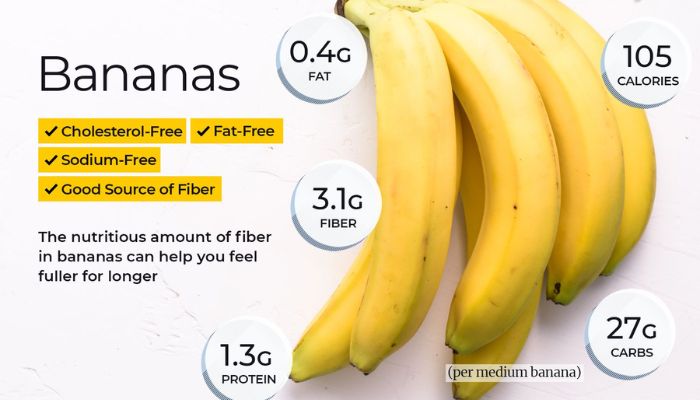
Quick answer: How many calories in a banana? It comes down to size: a medium banana (about 118 g once peeled) provides roughly 105 calories, along with 27 g of carbs, 1.3 g protein and 3.1 g fiber. Every 100 g of banana flesh adds up to 89 calories.
Most people overestimate the calories in a banana, often by a wide margin. The fruit has a reputation for being sugary, yet one medium banana costs you less energy than a typical granola bar, and it arrives with fiber, potassium and its own wrapper. This guide breaks down every size and form using USDA FoodData Central data.
Table of Contents
Banana calorie chart by size
| Size (length on the outer curve) | Calories | Peeled weight | Carbs | Fiber |
|---|---|---|---|---|
| Extra small, under 6 inches | 72 | 81 g | 19 g | 2.1 g |
| Small, 6 to 7 inches | 90 | 101 g | 23 g | 2.6 g |
| Medium, 7 to 8 inches | 105 | 118 g | 27 g | 3.1 g |
| Large, 8 to 9 inches | 121 | 136 g | 31 g | 3.5 g |
| Extra large, over 9 inches | 135 | 152 g | 35 g | 3.9 g |
| Any banana, per 100 g | 89 | 100 g | 23 g | 2.6 g |
Use this chart whenever you need the calories in a banana at a glance. Measure along the outer, curved edge. For the most accurate number, weigh the peeled fruit on a kitchen scale and multiply that weight by 0.89.
How to estimate without a scale
No kitchen scale? These shortcuts get you close enough for everyday tracking:
- Compare it with your hand. A banana roughly as long as your hand from wrist to fingertip is usually a medium.
- Count the peel. The peel is about a third of a banana’s total weight, so a whole unpeeled banana of 180 g is roughly 118 g of fruit.
- Use slices. One cup of sliced banana is about 150 g, or 134 calories. One cup mashed is about 225 g, or 200 calories.
- When unsure, log a medium. At 105 calories it sits in the middle of the range.
Calories in a banana plus full nutrition facts (medium, 118 g)
| Nutrient | Amount | % Daily Value |
|---|---|---|
| Calories | 105 | |
| Carbohydrate | 27 g | 10% |
| Sugars | 14.4 g | |
| Fiber | 3.1 g | 11% |
| Protein | 1.3 g | |
| Fat | 0.4 g | |
| Potassium | 422 mg | 9% |
| Vitamin C | 10.3 mg | 11% |
Daily values are based on the FDA’s reference amounts for adults. Carbohydrate supplies nearly every calorie in this fruit, while protein and fat barely register. That is the reason a banana eaten alone can leave you hungry soon after, and why adding a protein food helps.
Do riper bananas have more calories?
Ripening barely moves the calories in a banana. Weight for weight, an under-ripe green banana and a freckled one carry close to the same energy. Ripening mostly reshuffles the carbohydrate:
- Green: rich in resistant starch, a slow-digesting carb that acts partly like fiber.
- Yellow: much of that starch has turned to sugar, so the flavor is sweeter and the texture softer.
- Speckled brown: the sweetest stage and the best one for baking, since the fruit can cover part of a recipe’s sugar.
How bananas compare with other fruit
| Fruit (per 100 g) | Calories |
|---|---|
| Strawberries | 32 |
| Pineapple | 50 |
| Apple, with skin | 52 |
| Blueberries | 57 |
| Kiwi | 61 |
| Grapes | 69 |
| Figs | 74 |
| Banana | 89 |
| Plantain, yellow | 122 |
A banana holds less water than berries, melon or apples, so it packs more calories into each gram, but the calories in a banana still make it a modest snack. Plantains look similar but are starchier and usually cooked, so do not swap the numbers. Our apple guide lists calories in an apple by size and variety, or check raspberry calories for a lower-calorie berry.
Fresh vs dried banana vs banana chips
Processing changes the calories in a banana dramatically, mostly because water is removed or oil is added. Per ounce (28 g), using USDA values:
| Form | Calories per ounce |
|---|---|
| Fresh banana | 25 |
| Dehydrated banana | 98 |
| Banana chips (fried) | 147 |
Most banana chips are deep-fried and many are sugared too, so a few small handfuls can easily beat a whole fresh banana for calories. If you love a crunchy fruit snack, our oil-free air fryer apple chips are a lighter option.
What you get for the calories in a banana
Numbers alone tell part of the story. For about 105 calories, a medium banana supplies roughly a tenth of your daily fiber, potassium and vitamin C, along with quick energy from natural carbohydrate. That is a good return compared with many packaged snacks of the same size, which often provide calories with little fiber.
Bananas also need no preparation, travel well and are inexpensive year-round. That convenience matters: the easiest healthy snack is the one you actually have with you. Keeping the calories in a banana in mind simply helps you choose the right size and pair it well.
Can bananas fit a weight-loss plan?
No one food makes the scale move by itself, yet bananas suit a calorie-aware eating plan well:
- Built-in portions. Each fruit is a predictable size, so logging it takes seconds.
- Some staying power. Roughly 3 g of fiber in a medium one.
- A swap for richer desserts. Mashed ripe banana can cut sugar and butter in muffins, and frozen chunks whip into a creamy soft-serve.
- Handy fuel before exercise. Its carbs are digested quickly.
Banana snack pairings, with calories
For a more filling snack, add protein or a little healthy fat. Each total uses a medium banana and USDA values:
| Pairing | Calories |
|---|---|
| Banana + 1 tbsp peanut butter | 201 |
| Banana + 6 oz plain nonfat Greek yogurt | 205 |
| Banana sliced over 1/4 cup Greek yogurt fruit dip | 162 |
Our 57-calorie Greek yogurt fruit dip is an easy match for banana slices.
Banana products: watch the extras
Whole, a banana is a light choice. Once it is fried, baked or blended with extras, the totals climb.
- Banana bread behaves more like cake than fruit; a large bakery slice can pass 400 calories.
- Smoothies creep up fast: banana, milk and a scoop of peanut butter add up to a small meal.
- Banana desserts like splits and puddings get most of their calories from cream, sugar and toppings.
Simple ways to enjoy bananas
- Top porridge or yogurt with banana coins in place of syrup.
- Add frozen chunks to smoothies for sweetness and a thick texture.
- Stir mashed ripe banana into pancake or muffin batter and cut back the sugar.
- Blend frozen slices on their own into a one-ingredient soft-serve.
Common mistakes when counting calories in a banana
- Logging every banana as “medium”. A large banana has about 30 more calories than a small one, which adds up if you eat one daily.
- Weighing with the peel. Calorie figures are for the peeled fruit.
- Using fresh numbers for dried fruit. Dried banana is roughly four times more calorie-dense by weight.
- Forgetting the add-ons. Nut butter, honey and granola often outweigh the fruit itself.
For more help logging food accurately, read our guide on how to track calories or browse all of our calorie guides.
Frequently asked questions
What are the calories in a banana of medium size?
Roughly 105. That figure applies to a banana 7 to 8 inches long, weighing about 118 g without the peel.
Is the energy in a banana mostly from sugar?
Partly. In a ripe banana, natural sugar makes up roughly half the carbohydrate, with starch and fiber making up the rest. Less ripe fruit holds more starch.
Can I eat a banana daily?
Most healthy adults can. One banana a day sits comfortably within a balanced eating pattern and contributes to the fruit you need each day.
Does freezing lower the calories in a banana?
No. A frozen banana carries the same calories as an unfrozen one of equal weight; freezing changes texture, not energy.
Sources
- USDA FoodData Central: raw bananas, dehydrated bananas; banana chips; plantains; strawberries, apples, blueberries and other fruit.
- FDA: Daily Value on the Nutrition Facts Label.
- Dietary Guidelines for Americans: advice on daily fruit.
Nutrition information here is an estimate based on average sizes. This article is general information, not medical advice.