Quick answer: Bagel calories depend mostly on size. A medium plain bagel (105 g) has about 277 calories, 55 g of carbohydrate and 11 g of protein. A large bagel (131 g) has about 346 calories before any spread, and 2 tablespoons of regular cream cheese adds about 101 more.
Bagel calories are easy to underestimate. A bagel looks like one piece of bread, but it’s dense and heavy, so a medium bagel carries about as many calories as three to four slices of sandwich bread. The good news is that a few simple choices, like the size you pick and what you put on it, can change the total by 200 calories or more.
Below you’ll find bagel calories by size and type, what common toppings add, how bagels compare with other breakfast breads, and easy ways to build a lighter bagel breakfast. All numbers come from USDA FoodData Central.
Table of Contents
Bagel calories by size
| Plain bagel size | Weight | Calories | Carbs | Protein |
|---|---|---|---|---|
| Mini (2.5 in) | 26 g | 69 | 14 g | 2.8 g |
| Small (3 in) | 69 g | 182 | 36 g | 7.3 g |
| Medium (3.5 to 4 in) | 105 g | 277 | 55 g | 11.1 g |
| Large (4.5 in) | 131 g | 346 | 69 g | 13.9 g |
| Per 100 g | 100 g | 264 | 52.4 g | 10.6 g |
Bakery and coffee-shop bagels are often bigger than the USDA “large”. If yours looks oversized, weigh it once or check the shop’s nutrition page; a 150 g bagel would be close to 400 calories on its own.
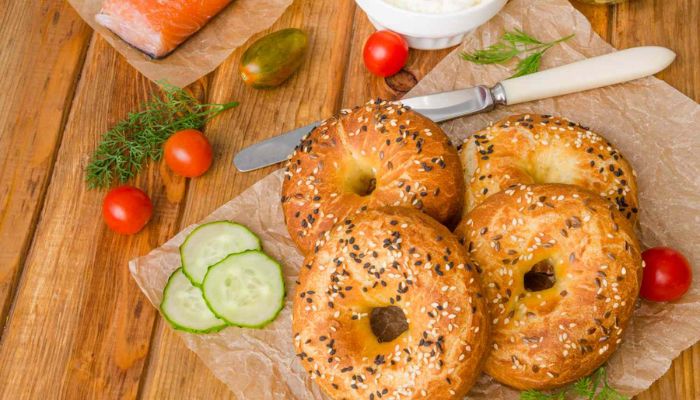
Bagel calories by type
Per 100 g, the differences between bagel types are fairly small. Fiber is where they really differ.
| Bagel type (per 100 g) | Calories | Fiber |
|---|---|---|
| Multigrain | 241 | 6.2 g |
| Plain (includes onion, poppy, sesame) | 264 | 1.6 g |
| Egg | 278 | 2.3 g |
| Plain, toasted | 287 | 1.8 g |
Toasting doesn’t add calories. It drives off water, so the same bagel weighs a little less afterwards and the per-gram number goes up, but the total for the whole bagel stays the same.
A typical multigrain bagel in the USDA data weighs 81 g and has about 195 calories with 5 g of fiber, which makes it one of the more filling choices.
How much toppings add to bagel calories
The spread can add almost as much as the bagel itself. Here’s what common toppings add, per typical portion:
| Topping | Portion | Calories | Protein |
|---|---|---|---|
| Fat-free cream cheese | 2 tbsp (29 g) | 30 | 4.6 g |
| Smoked salmon (lox) | 1 oz (28 g) | 33 | 5.2 g |
| Cottage cheese, 2% | 1/4 cup (57 g) | 46 | 5.9 g |
| Avocado | 1/4 fruit (34 g) | 57 | 0.7 g |
| Low-fat cream cheese | 2 tbsp (29 g) | 60 | 2.3 g |
| Hard-boiled egg | 1 large (50 g) | 78 | 6.3 g |
| Regular cream cheese | 2 tbsp (29 g) | 101 | 1.8 g |
| Butter | 1 tbsp (14 g) | 102 | 0.1 g |
| Peanut butter | 2 tbsp (32 g) | 191 | 7.1 g |
A medium plain bagel with regular cream cheese comes to about 378 calories. With the low-fat version it drops to about 337, and with a thick layer of peanut butter it rises to about 468.
Bagel vs other breakfast breads
| Bread | Portion | Calories | Protein |
|---|---|---|---|
| English muffin | 1 muffin (57 g) | 129 | 5.1 g |
| Whole-wheat bread | 2 slices (64 g) | 161 | 8.0 g |
| Butter croissant | 1 medium (57 g) | 231 | 4.7 g |
| Plain bagel | 1 medium (105 g) | 277 | 11.1 g |
A medium bagel has more calories than a croissant simply because it’s almost twice as heavy, but it has far less fat and more than twice the protein. An English muffin or two slices of whole-wheat toast give you a similar sandwich base for roughly half the calories.
Are bagels healthy?
Bagels are mostly refined carbohydrate with modest protein and little fiber, unless you choose a whole-grain or multigrain version. They’re also fairly high in sodium: a medium plain bagel has about 440 mg, nearly a fifth of the 2,300 mg daily limit in the Dietary Guidelines for Americans.
That doesn’t make them off-limits. It just means the portion size and toppings do most of the work. A bagel paired with protein and vegetables is a very different breakfast from a large bagel with butter and jam.
3 lighter bagel breakfasts
These combinations keep bagel calories in check while adding protein, which helps a bagel breakfast last until lunch.
| Breakfast | What’s in it | Calories |
|---|---|---|
| Half-bagel lox | 1/2 medium plain bagel, 1 tbsp low-fat cream cheese, 1 oz smoked salmon, tomato and cucumber | about 216 |
| Multigrain egg bagel | 1 multigrain bagel (81 g), 1 hard-boiled egg sliced, spinach and tomato | about 285 |
| Cottage cheese bagel | 1/2 medium plain bagel, 1/4 cup 2% cottage cheese, sliced tomato, black pepper | about 194 |
Want something sweet instead? Half a medium bagel with 1 tablespoon of peanut butter and half a sliced banana comes to about 288 calories. See our calories in a banana guide for the fruit numbers.
Easy ways to make bagel calories go further
- Choose a smaller or thin bagel, or eat half and save the rest for tomorrow.
- Scoop it. Removing some of the soft center trims calories while keeping the chewy crust.
- Pick a high-fiber bagel, such as multigrain or whole wheat.
- Add protein. Smoked salmon, eggs or cottage cheese make a more filling meal than cream cheese alone.
- Load it with vegetables: tomato, cucumber, red onion and spinach add volume for very few calories.
- Measure the spread once. Seeing what 2 tablespoons of cream cheese looks like makes it much easier to judge later.
Common mistakes with bagel calories
- Logging “1 bagel” for any size. A large bakery bagel can have double the calories of a small supermarket one.
- Forgetting the spread. Butter or peanut butter can add 100 to 200 calories that never make it into a food log. Our guide on how to track calories explains how to log these properly.
- Assuming “multigrain” means low calorie. It means more fiber, not necessarily fewer calories per bagel; check the weight.
- Pairing it with a sweet drink. A flavored latte can add more than the bagel. Compare options in our coffee calories guide.
How to estimate bagel calories when eating out
Coffee shops and bagel bakeries rarely use the USDA sizes. If the shop doesn’t post nutrition information, judge by size: a bagel that fills your palm is close to a medium (about 277 calories), while one that’s wider than your hand is likely 350 to 400 calories or more. Specialty bagels with cheese baked on top, sweet swirls or stuffed fillings will have more calories than a plain one of the same size.
Storing and freezing bagels
Bagels go stale quickly at room temperature, which is one reason people end up eating a whole one instead of half. Slice fresh bagels in half before freezing them in a sealed bag. You can then toast one half straight from frozen whenever you want it, which makes portion control much easier.
Store-bought bagels keep for a few days in their sealed bag at room temperature. Avoid the fridge, which tends to make bread go stale faster.
If you buy bagels from a bakery, slice them yourself just before freezing. Wrapping each half separately in parchment stops them sticking together, so you can grab exactly one portion at a time.
Frequently asked questions
How many bagel calories are in a plain bagel?
A medium plain bagel (105 g) has about 277 calories and a large one (131 g) has about 346, according to USDA data.
Does toasting change bagel calories?
No. Toasting removes water, not calories, so the total for the whole bagel stays the same.
Is half a bagel a good breakfast?
Half a medium bagel is about 139 calories. Add eggs, smoked salmon or cottage cheese for protein and it becomes a balanced, lighter meal.
Which bagel has the fewest calories?
Smaller and thinner bagels have the fewest calories overall. Per gram, multigrain bagels are slightly lower than plain or egg bagels and have much more fiber.
Building a breakfast? Compare bacon calories and egg calories, or browse our full list of calorie guides.
Sources
- USDA FoodData Central: bagels (plain, toasted, multigrain, egg); cream cheese (regular, low fat, fat free); smoked salmon; cottage cheese 2%; avocado; hard-boiled egg; butter; peanut butter; English muffin; whole-wheat bread; butter croissant.
- Dietary Guidelines for Americans: sodium limit.
Nutrition values are estimates based on USDA FoodData Central averages and vary by brand, size and preparation. This article is general information, not medical advice.